

The Archive 1927–2000 of the Konzertvereinigung Wiener Staatsopernchor
 Nächstes Jahr
1927: The Founding of the Concert Association
Just as the orchestra of the Vienna State Opera once founded its own concert ensemble (the “Vienna Philharmonic”), choir member Viktor Maiwald (photo) established the “Konzertvereinigung Wiener Staatsopernchor” in 1927. Following the model of the Vienna Philharmonic, which emerged from the State Opera orchestra, the choir was intended to enrich the music scene as a professional concert choir outside of the State Opera as well. The original goal has remained unchanged throughout all these years: to prepare works of choral literature with all great conductors and important orchestras, and to present them to the audience in concerts of the highest quality.
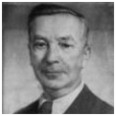
Viktor Maiwald
1927 – 1936
1927: Founding of the Konzertvereinigung Wiener Staatsopernchor by choir member Viktor Maiwald on January 5. First concert together with the Vienna Philharmonic conducted by Opera Director Franz Schalk (Bach: Mass in B minor) on March 10.
1928: The 100th anniversary of Franz Schubert’s death shapes the musical programming of this year, such as an open-air concert at Vienna’s Josephsplatz together with the Vienna Philharmonic.
1929: First a cappella concert on April 10, also under the conductorship of Franz Schalk (Bach, di Lasso, Brahms, and the world premiere of the 16-part choir piece Der Abend by Richard Strauss).
1930: Second a cappella concert on April 25, also under Franz Schalk, featuring works by Schönberg, Palestrina, Bach, Brahms, and the world premiere of the 16-part choir piece Hymne by Richard Strauss, who is present in the audience.
1931: Following the death of Franz Schalk, the proven choir expert Ferdinand Großmann takes over the Konzertvereinigung Wiener Staatsopernchor as choral director. The takeover of the State Opera directorate by Clemens Krauss proves to be a stroke of good fortune, as he shows full understanding for the plans and projects of the KV (Concert Association).
1932: On the occasion of Joseph Haydn’s 200th birthday, numerous concerts featuring his works take place.
1933: 10 years of participation in the Salzburg Festival (including the Verdi Requiem under Bruno Walter) and a gala concert conducted by Otto Klemperer at the German Katholikentag in Vienna.
1934: Concert guest performances in Budapest and Berlin with a cappella works. Toscanini conducts the Verdi Requiem at the Vienna State Opera in memory of the assassinated Federal Chancellor Dollfuss.
1935: From this year onward, highly successful concert activities under Arturo Toscanini and the new Opera Director Felix Weingartner. Winning the Grand Prix at the choir competition of the Paris World’s Fair under the new choral director, Bruno Walter. During these years, concerts are held under Hans Knappertsbusch, Wilhelm Furtwängler, and Josef Krips.
1936: Toscanini conducts two performances of A German Requiem in Vienna and Salzburg, as well as the Liebeslieder Waltzes by Johannes Brahms in Budapest.

The Konzertvereinigung Wiener Staatsopernchor with Franz Schalk
1937 – 1946
1937: 10 years of the Konzertvereinigung Wiener Staatsopernchor. Gala concert under Bruno Walter at the Musikverein. St. Matthew Passion under Hans Knappertsbusch, who is so impressed by the choir that he jokingly names them the “Hundred-Headed Kammersänger”. Concert tour to Rome with an audience with Pope Pius XI.
1938: The annexation of Austria into Germany (the Anschluss) is more important to the general public of those days than any cultural events (including, of course, those of the Concert Association). Neither Beethoven’s 9th Symphony in Salzburg nor Brahms’ A German Requiem in Vienna can find the usual audience response.
1939: In the first year of World War II, Clemens Krauss brings the choir to Munich for several opera performances, where they perform Lohengrin and Tannhäuser alongside the local choir.
1940: In the second year of the war, Prof. Ferdinand Großmann permanently resigns from his post in protest against the arbitrary appointment of a new Opera Director by the rulers of the Third Reich; Richard Roßmayer takes over as the new choral director.
1941: Clemens Krauss organizes a series of radio recordings for the choir to bridge the war-induced “lack of culture.”
1942: On the occasion of their 100th anniversary, the Vienna Philharmonic awards the Nicolai Medal (named after their founder) to the Konzertvereinigung Wiener Staatsopernchor.
1943: 20 years of participation in the Salzburg Festival. Otherwise, everyday life consists of concert opera performances for the radio. An exception is the Verdi Requiem under Knappertsbusch.
1944: Concerts take place in the otherwise closed State Opera House, such as Beethoven’s 9th Symphony.
1945: Immediately after the end of World War II, Josef Krips takes over the position of choral director and begins with a cappella concerts in the undamaged Volksoper (the State Opera burned down completely just before the end of the war due to an Allied bombing raid).
1946: Since the other established choirs in Vienna (Singakademie and Singverein) are severely weakened by the war and must first be reorganized and trained again, the main burden of Viennese concert life in the post-war years rests primarily on the shoulders of the Konzertvereinigung Wiener Staatsopernchor.
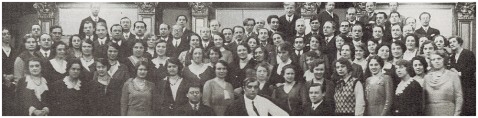
The Konzertvereinigung Wiener Staatsopernchor with Clemens Krauss.
1947 – 1956
Konzertvereinigung Wiener Staatsopernchor1947: 20 years of the Konzertvereinigung Wiener Staatsopernchor. World premiere of Richard Strauss’s An den Baum Daphne, which he dedicated specifically to the Konzertvereinigung Wiener Staatsopernchor. Participation of the Concert Association in the world premiere of Gottfried von Einem’s Dantons Tod (Danton’s Death) in Salzburg (conducted by Ferenc Fricsay).
1948: Following the far too early death of the KV founder and chairman Viktor Maiwald, Franz Szkokan takes over his office.
1949: Having returned, Clemens Krauss, acting as concert director, attempts to launch the “Philharmonic Academies” as a counterpart to the subscription concerts of the Vienna Philharmonic.
1950: Unfortunately, after just the third Philharmonic Academy, this project can no longer be continued.
1951: An internationally acclaimed triumph during a guest performance in Switzerland with the Vienna Philharmonic under Clemens Krauss.
1952: 25th anniversary of existence. Heinrich Kralik writes in the press: “…What the Konzertvereinigung Wiener Staatsopernchor has contributed in terms of beautiful, great, and noble music over the course of this time occupies a place of honor in our musical life…”
1953: 30 years of participation in the Salzburg Festival, active recording work for the radio, and concert tours abroad to Switzerland and France.
1954: Following the death of Clemens Krauss, Karl Böhm takes the lead of the Konzertvereinigung Wiener Staatsopernchor.
1955: In the year of the solemn reopening of the Vienna State Opera, the Konzertvereinigung Wiener Staatsopernchor had the opportunity to shine together with the Vienna Philharmonic under Bruno Walter at a concert in the “Haus am Ring” (the Opera House), performing Bruckner’s Te Deum and Beethoven’s 9th Symphony.
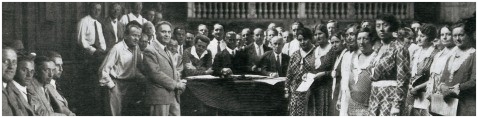
The Konzertvereinigung Wiener Staatsopernchor with Bruno Walter.
1957 – 1966
1957: On the occasion of the 30th anniversary of the Konzertvereinigung Wiener Staatsopernchor: The scenic staging of an a cappella concert with Gregorian chants and works by Palestrina under Herbert von Karajan is celebrated as a sensation.
1958: Beethoven’s 9th Symphony at a gala performance in Brussels under the direction of Herbert von Karajan.
1959: The opening of the newly built Large Festival Hall (Großes Festspielhaus) in Salzburg provides ample opportunities for the Konzertvereinigung Wiener Staatsopernchor to impressively showcase its talents.
1960: Following a brilliant performance by the Konzertvereinigung Wiener Staatsopernchor in the Verdi Requiem under Giulini at the Vienna Musikverein, several newspaper critics call for more involvement of the KV in the concert sector, which is, however, not possible due to increased duties at the State Opera.
1962: From 1962 to 1982, the Konzertvereinigung Wiener Staatsopernchor participates in the Bregenz Festival.
1963: 40 years of participation in the Salzburg Festival: The city of Salzburg honors the Concert Association with an official ceremony.
1964: Concert guest performances in the Austrian federal states resume, featuring the Verdi Requiem.
1965: At the Salzburg Festival, Claudio Abbado conducts Mahler’s 2nd Symphony, and Herbert von Karajan provides the highlight of the summer with his production of Boris Godunov.
1966: This year brings the ensemble’s sensational collaboration with Leonard Bernstein and director Luchino Visconti for the Vienna Festival (Wiener Festwochen) production of Verdi’s Falstaff.
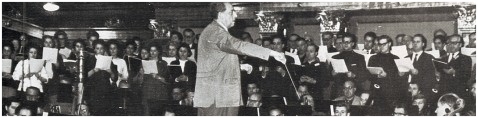
The Konzertvereinigung Wiener Staatsopernchor with Richard Roßmayer.
1967 – 1976
1967: 40 years of the Konzertvereinigung Wiener Staatsopernchor. Renewed collaboration with Leonard Bernstein and a guest performance in Toronto.
1969: Under its new choral director, Norbert Balatsch, the Konzertvereinigung Wiener Staatsopernchor only now returns to concert life, singing among other events at the gala matinee celebrating “100 Years of the Vienna Opera on the Ring” under Leonard Bernstein.
1970: This year, Herbert von Karajan brings the Konzertvereinigung Wiener Staatsopernchor to the Salzburg Easter Festival and to Berlin for several concerts.
1971: For the first time, the Konzertvereinigung Wiener Staatsopernchor participates in the Carinthian Summer festival (Carinthischer Sommer); a concert tour leads to Moscow.
1972: First collaboration with the young Riccardo Muti at the Salzburg Festival.
1973: 50 years of participation in the Salzburg Festival: Gala concert featuring Bruckner’s Te Deum and Mozart’s Coronation Mass, prepared by the Salzburg choral director Walter Hagen-Groll, performed with the Vienna Philharmonic under Herbert von Karajan.
1974: First Advent concert under Bernhard Klebel at the Franciscan Church (Franziskanerkirche) in Vienna.
1975: Since this year, the Concert Association has been an integral part of the Vienna Festival (Wiener Festwochen).
1976: First appearance at the Linz Brucknerhaus (Brucknerhalle) with Haydn’s The Seasons under Kurt Wöss.
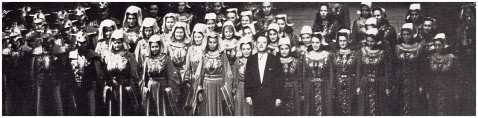
The Konzertvereinigung Wiener Staatsopernchor with Prof. Walter Hagen-Groll.
1977 – 1986
1977: 50 years of the Konzertvereinigung Wiener Staatsopernchor. On the initiative of the chairman at the time, Prof. Helmut Pilss, the first All Saints’ Day concert (Allerheiligenkonzert) takes place with Carlo Maria Giulini (J. Brahms: A German Requiem).
1978: Giulini brings the Konzertvereinigung Wiener Staatsopernchor to Milan with A German Requiem for the gala matinee celebrating “200 Years of La Scala”.
1979: Leonard Bernstein conducts a concert on the occasion of the opening of Vienna’s UNO-City and organizes a large-scale USA tour to Washington and New York with Fidelio and Beethoven’s 9th Symphony.
1980: The Konzertvereinigung Wiener Staatsopernchor honors Herbert von Karajan with the Clemens Krauss Medal in Gold.
1981: In November, the All Saints’ Day concert is broadcast live on TV from the Musikverein for the first time.
1982: Igor Stravinsky’s Oedipus Rex at the Salzburg Festival, as well as his Symphony of Psalms at the 6th All Saints’ Day concert, are among the highlights on the Konzertvereinigung Wiener Staatsopernchor’s concert calendar.
1983: 60 years of participation in the Salzburg Festival. A cappella concert at Vienna’s Wotruba Church (Wotrubakirche) under Helmut Froschauer.
1984: A cappella Christmas concerts at Vienna’s Mozart Hall (Mozartsaal) and in the theater hall of the psychiatric hospital at Baumgartner Höhe.
1985: Within the framework of the British Weeks, Edward Elgar’s The Dream of Gerontius is performed at the Konzerthaus. Fittingly, Benjamin Britten’s War Requiem is performed at the 9th All Saints’ Day concert.
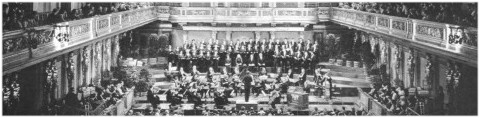
The Konzertvereinigung Wiener Staatsopernchor at an All Saints’ Day concert.
1987 – 1996
1987: A cappella gala at the Vienna State Opera on the occasion of the 60th anniversary of the Konzertvereinigung Wiener Staatsopernchor, featuring the elderly Roberto Benaglio, who has worked with the choir as a coach for the “Italian repertoire” since the Karajan era. Claudio Abbado is appointed as the new concert director.
1988: The Swedish choral conductor Eric Ericson is invited by the Konzertvereinigung Wiener Staatsopernchor to prepare Brahms’s A German Requiem for the 12th All Saints’ Day concert under N. Harnoncourt.
1989: In this year, the Konzertvereinigung Wiener Staatsopernchor successfully tackles two parallel productions of Gustav Mahler’s 8th Symphony (at the Konzerthaus as a Vienna Festival concert under Georges Prêtre, and at the Musikverein as a record recording under Lorin Maazel). The 13th All Saints’ Day concert in Tokyo (during a guest performance of the Vienna State Opera) – in memoriam Herbert von Karajan – is broadcast to Europe on time-delayed television.
1990: The Konzertvereinigung Wiener Staatsopernchor celebrates the 90th anniversary of the Vienna Symphony (Wiener Symphoniker) with Carlo Maria Giulini, and dedicates the All Saints’ Day concert to the recently deceased Leonard Bernstein.
1991: On the occasion of the Mozart Year, the Konzertvereinigung Wiener Staatsopernchor sings Mozart’s Requiem at St. Stephen’s Cathedral (Stephansdom) in Vienna under the direction of Sir Georg Solti.
1992: Opening concert of the Vienna Festival with Schönberg’s Gurrelieder under Claudio Abbado. Subsequently, the Konzertvereinigung Wiener Staatsopernchor participates in a Rossini concert at the Theater an der Wien, interpreting the Stabat Mater under the direction of Giuseppe Sinopoli. Alte Oper Frankfurt: Berlioz’s Te Deumas part of the Opera Festival, again under Claudio Abbado.
1993: 70 years of participation in the Salzburg Festival.
1994: The year begins with a record recording of Le nozze di Figaro (Claudio Abbado). Participation in the opening of the Vienna Festival under the motto “The Feast of Prince Orlofsky” (Domingo, Baltsa) in front of the Vienna City Hall (28,000 visitors).
1995: One of the most soulful CD productions of the Konzertvereinigung Wiener Staatsopernchor is created: Rossini’s Stabat Materwith the Vienna Philharmonic under Myung-Whun Chung. At the State Opera, Gustav Mahler’s 2nd Symphony is performed on the anniversary of his death, with Seiji Ozawa conducting the Vienna Philharmonic. On the occasion of “1000 Years of the City of Krems,” Fabio Luisi conducts Beethoven’s 9th Symphony in Krems and at the Musikverein. Giuseppe Sinopoli records a new version of Elektra at the Musikverein.
1996: Concert at the Vienna State Opera under the direction of Carlo Maria Giulini (Bruckner: Te Deum). Regular invitations of the Konzertvereinigung Wiener Staatsopernchor to the Ravenna Festival (Riccardo Muti) – 1996/1999/2002 – with productions of Così fan tutte, Don Giovanni, and Le nozze di Figaro.

The Konzertvereinigung Wiener Staatsopernchor with Roberto Benaglio.
1997 – 2000
1997: 70 years of the Konzertvereinigung Wiener Staatsopernchor.
1998: 75 years of participation in the Salzburg Festival.
1999: Under the direction of Zubin Mehta, the women’s chorus of the Konzertvereinigung Wiener Staatsopernchor performs brilliantly in Mahler’s 3rd Symphony at the Vienna State Opera.
With the beginning of the third millennium, starting from 2001, each year is given its own archive page, where the events, dates, performances, and personnel details of the Konzertvereinigung Wiener Staatsopernchor can be read in detail.